For agencies, white label link building is a practical way to deliver results without building an outreach team in-house. But you’re putting your reputation, and your clients’ rankings, in someone else’s hands. The wrong provider can produce reports full of impressive metrics while quietly building links that do nothing or create real risk. These are the questions worth asking before you sign up.
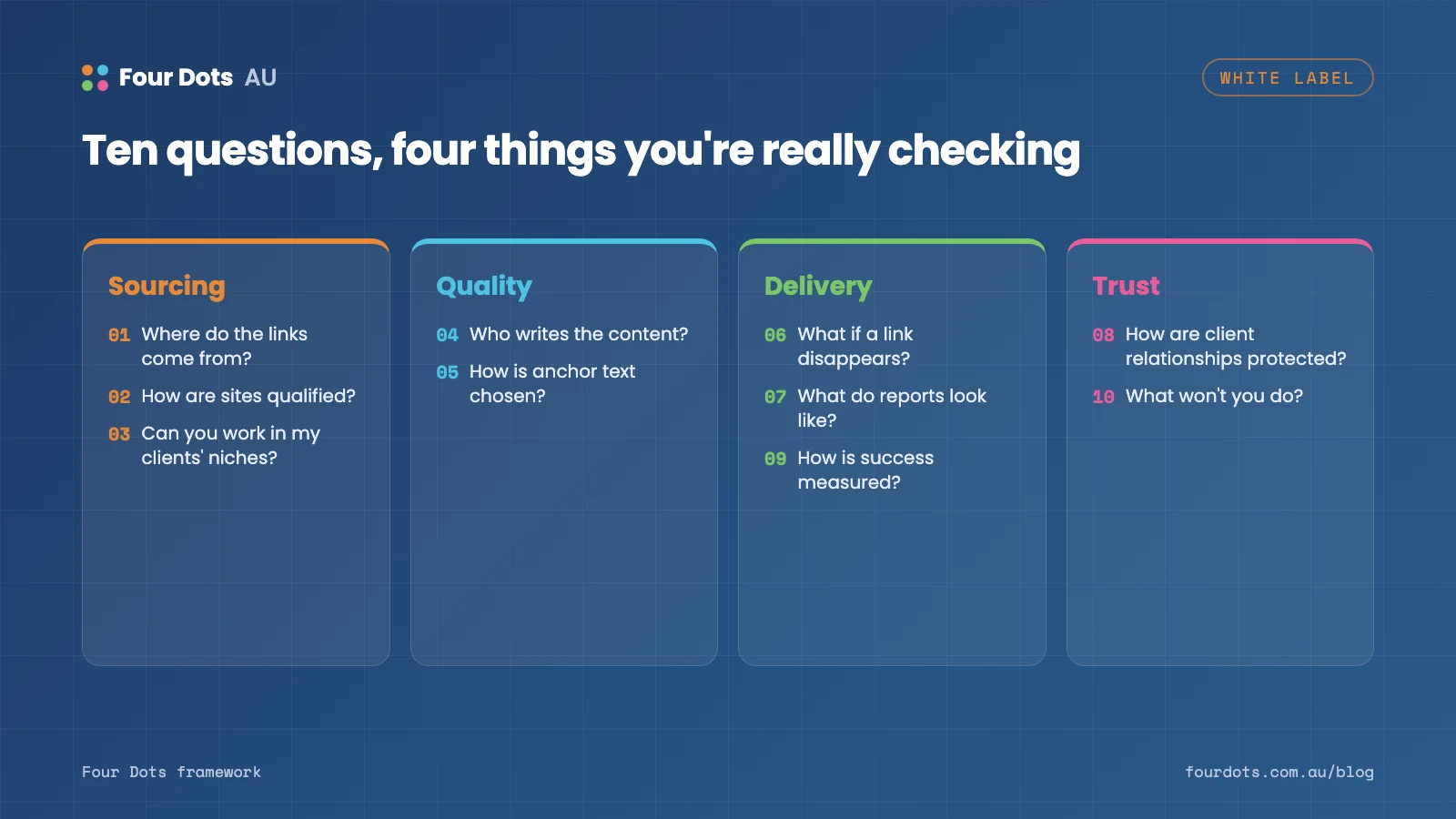
1. Where do the links actually come from?
Ask for sample placements from recent campaigns, with live URLs. Look at the sites yourself. Do they have real organic traffic? Are they relevant to the clients they’re linking to? Do they publish content people would actually read? A provider that won’t show examples, or only shows screenshots, is a warning sign.
2. How do you find and qualify sites?
Good providers can explain their vetting process: minimum traffic thresholds, relevance checks, manual review, and how they screen out link farms and private blog networks. (Our guide to what a quality placement looks like lists the checks.) If the answer is “we have a database of 20,000 sites”, ask how many of those were added because they accept every submission.
3. Can you build links in my clients’ niches and markets?
Placing links for a Sydney plumber, a national law firm and a US software company requires different sites and different outreach. Ask about experience in the specific industries and countries your clients operate in, and request niche-relevant examples.
4. Who writes the content, and can I review it?
Content quality affects whether placements get accepted by quality sites and how the link is perceived. Ask who writes the articles, whether they’re written for the publisher’s audience, and whether you can approve topics or drafts for sensitive clients.
5. How is anchor text chosen?
A responsible provider will recommend a natural mix of branded, URL, partial and descriptive anchors, informed by each client’s existing profile, rather than pushing exact-match keywords on every link. Google’s spam policies list optimised anchor text in articles placed on other sites as an example of link spam.
6. What happens if a link disappears?
Links sometimes get removed or sites go offline. Ask how long placements are monitored and whether lost links are replaced.
7. What do the reports look like, and can I brand them?
You need reports you can pass to clients under your own brand, with every live URL, the target page, anchor text and key site metrics. Ask for a sample report before you commit.
8. How do you protect my client relationships?
White label means the provider stays invisible. Confirm they won’t contact your clients directly, reference them publicly or use them as case studies without your permission, and that confidentiality is covered in your agreement.
9. How do you measure success?
Volume of links is an output, not an outcome. A good partner will talk about the effect on rankings, organic traffic and referring domains for the pages being supported, and will help you set realistic expectations with clients about timeframes.
10. What won’t you do?
This is often the most revealing question. Providers with high standards will tell you clearly which tactics and sites they avoid. If the answer is “nothing, we can get any link you want”, that tells you what you need to know.
Good answers vs red flags
| Question | Good answer | Red flag |
|---|---|---|
| Where do links come from? | Live sample URLs on sites with real traffic | Screenshots only, or “it’s confidential” |
| How are sites qualified? | Traffic thresholds, relevance checks, manual review | “We have 20,000 sites” |
| Niche experience? | Relevant examples in your clients’ industries | Same sites for every client |
| Who writes content? | Writers briefed for each publisher, approvals available | Spun or generic articles |
| Anchor text? | Natural mix based on each profile | Exact match by default |
| Lost links? | Monitoring and replacement policy | No answer |
| Reports? | White label, every URL, target and anchor | Totals without URLs |
| Client protection? | Confidentiality in the agreement | Contacts or names your clients |
| Success measures? | Rankings, traffic and referring domains | Link count only |
| What won’t you do? | A clear list of tactics they avoid | “Nothing” |
Whatever the provider says, check that paid placements are handled in line with Google’s guidance on qualifying outbound links. If you inherit a client with a messy history, start with a toxic backlink review.
FAQ
What is white label link building?
A provider builds links for your clients under your agency’s brand. You keep the client relationship and reporting; the provider handles prospecting, content and outreach behind the scenes.
How do I explain link building results to clients?
Report on live links alongside the outcomes they support: rankings, organic traffic and referring domains for the target pages. Set expectations that links compound over months, not weeks.
Can I review placements before they go live?
With a good provider, yes, at least at the topic or site-list stage. For sensitive clients, ask for draft approval as part of the agreement.
Choosing a partner
The right white label partner should feel like an extension of your team: transparent about where links come from, consistent in quality and discreet with your clients. Four Dots has delivered white label SEO and link building for agencies for years. Learn more about our white label SEO services and link building, or get in touch to request sample placements.