Guest posting remains one of the most reliable ways for Australian businesses to earn relevant links, but the gap between a good placement and a bad one is enormous. A strong article on a respected local site can lift rankings and send real referral traffic. A weak one on a link farm does nothing at best and creates risk at worst. Here’s how to tell the difference.
Why Australian placements matter
If you sell to Australians, links from Australian sites carry useful signals. They reinforce your geographic relevance, they’re more likely to send visitors who can actually buy from you, and they look natural alongside the rest of a local business’s link profile. A .com.au domain isn’t automatically better than an international one, but an audience that matches yours almost always is.
The signs of a quality placement
The site has a real audience
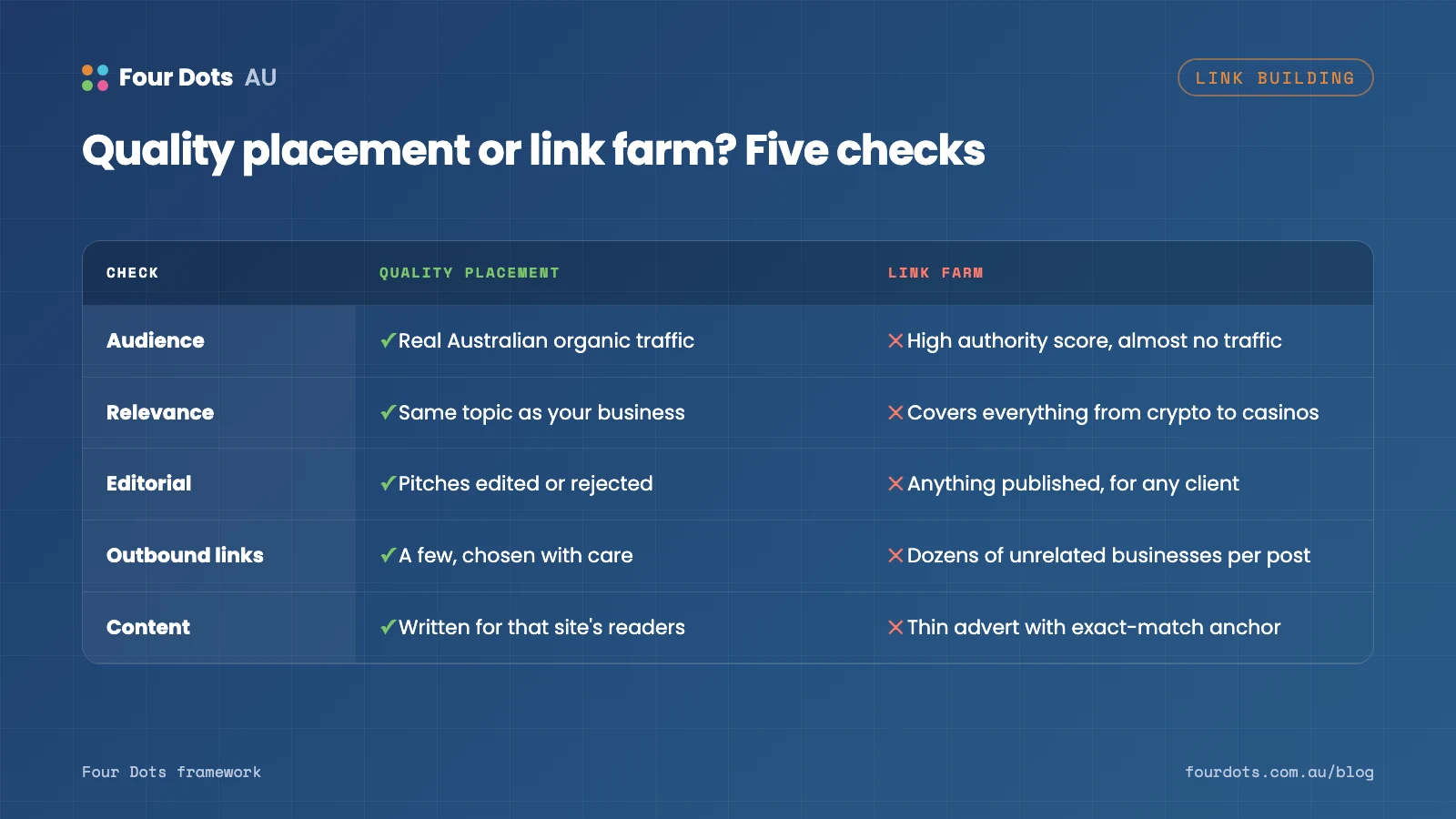
Look for organic traffic from Australia, not just a high authority score. Domain Rating and Domain Authority are third-party estimates that can be inflated; traffic from real searchers is much harder to fake. Check that the site ranks for sensible keywords related to its topic.
It’s topically relevant
A renovation business benefits far more from a home and lifestyle publication than from a general “news” site that covers everything from crypto to casinos. Relevance helps search engines understand your link and makes the article genuinely useful to readers.
It has editorial standards
Good publishers reject weak pitches, edit submissions and maintain a consistent style. Browse recent articles: if every post is a thinly disguised advert with an exact-match anchor in the first paragraph, move on.
Outbound links are selective
Sites that link out to dozens of unrelated businesses per post, or that openly advertise “guest posts for sale” across the homepage, are obvious to search engines too. Their links tend to be discounted.
The content is worth reading
The article itself should stand on its own: well researched, written for that publication’s readers, with your link placed where it naturally helps. If you wouldn’t be happy for a customer to read it, it isn’t a quality placement.
Anchor text and link placement
Natural link profiles are dominated by branded and descriptive anchors, with only an occasional exact-match keyword. Google’s link best practices also recommend anchor text that describes the destination in a natural way. Aim for variety: your brand name, your URL, a partial phrase (“our guide to pipe relining costs”) and generic anchors all have a place. Links within the body of an article are worth more than those in an author bio, and pointing to a genuinely relevant page beats sending everything to the homepage.
| Anchor type | Example | Role in a natural profile |
|---|---|---|
| Branded | Four Dots | The bulk of most healthy profiles |
| Naked URL | fourdots.com.au | Common, especially in citations and resource lists |
| Partial / descriptive | our guide to pipe relining costs | Adds topical context without over-optimising |
| Generic | this article, read more | Natural filler that real writers use |
| Exact match | pipe relining sydney | Use sparingly; a high share is a manipulation signal |
Staying within Google’s guidelines
Google’s spam policies treat links exchanged for money as link schemes unless they’re qualified with rel="sponsored" or rel="nofollow". That’s why the safest guest posting focuses on genuinely editorial content on relevant sites, earned through outreach and the quality of the article, rather than bulk-purchased placements on networks that exist only to sell links. When in doubt, ask whether the link would make sense if search engines didn’t exist.
Red flags to avoid
- A “menu” of hundreds of sites at flat prices, all with suspiciously similar metrics.
- Sites with high authority scores but little or no organic traffic.
- Publishers who guarantee placement on any topic, for any client.
- Articles that go live on pages buried deep in the site with no internal links.
- No reporting on where links were placed, or reluctance to share live URLs.
If you’ve already bought placements like these, our guide to spotting a toxic backlink profile explains how to assess the damage.
FAQ
Are guest posts still worth it for SEO?
Yes, when they’re editorial placements on relevant sites with real audiences. They’re one of the few scalable ways to earn contextual links. Bulk placements on sites that exist only to sell links are not worth it.
Do Australian businesses need .com.au links?
Not exclusively, but links from sites with Australian audiences reinforce local relevance and are more likely to send visitors who can buy from you. A relevant international site still beats an irrelevant local one.
How many guest posts do I need?
It depends on your competitors’ link profiles, not a fixed number. Look at the referring domains of the sites outranking you and close the gap with quality, relevant placements over time. Our link building services start with that gap analysis.
Making guest posting work
A handful of strong, relevant placements each month will outperform a large volume of weak ones. Pair guest posting with good on-site content and technical health, and track rankings and referral traffic for the pages you’re linking to. If you’d like a team to handle it, our Australian guest post service secures placements on real, relevant local sites, with full reporting on every link.