Most small businesses don’t have the budget for an enterprise-scale SEO program, and they don’t need one. Local service businesses, tradies, clinics and independent retailers usually compete in a defined area against a manageable number of competitors. Doing the fundamentals properly, in the right order, gets you most of the way. Here’s where to put your first hours and dollars.
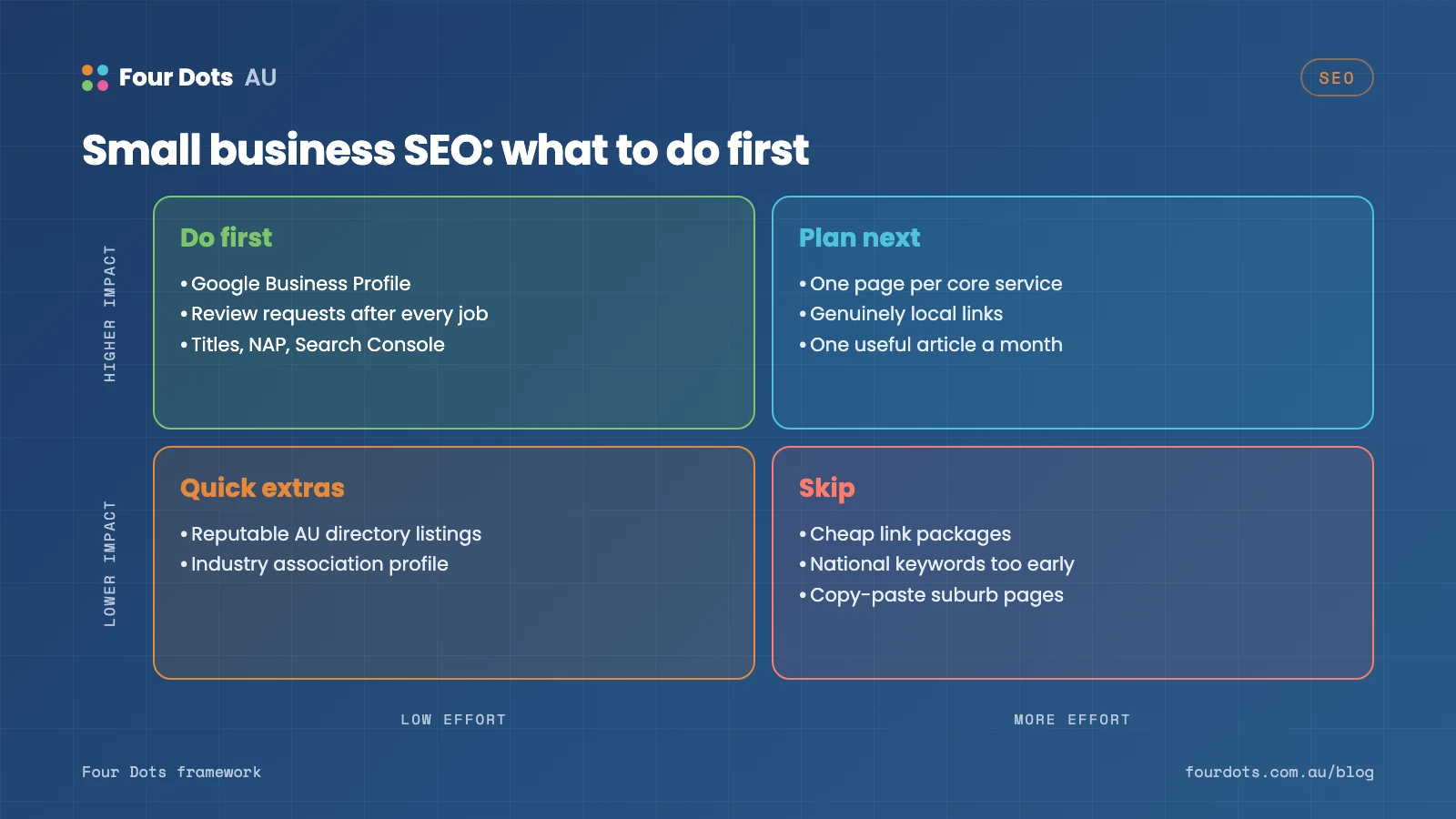
1. Set up and optimise your Google Business Profile
For any business that serves a local area, this is the highest-return task on the list, and it’s free. Google’s own tips to improve your local ranking are a good checklist. Claim and verify your profile, choose the most accurate primary category, add your services, service areas and opening hours, and upload real photos of your work, team and premises. Then keep it alive: post updates, add new photos and answer questions.
2. Start collecting reviews systematically
Reviews influence both local rankings and whether people choose you. Don’t wait for them to arrive on their own. Ask every happy customer, ideally with a direct link sent by text or email straight after the job. Google explains how to create and share a review link from your profile. Respond to every review, positive or negative, politely and promptly.
3. Fix the basics on your website
You don’t need a new website to do SEO, but your existing one has to get the essentials right:
- each important page has a unique, descriptive title tag and meta description;
- your business name, address and phone number are on every page and match your Google profile;
- the site loads quickly and works well on mobile (test it free with PageSpeed Insights);
- it’s connected to Google Search Console and an analytics tool, so you can see what’s happening;
- nothing important is accidentally blocked from search engines.
Google’s SEO Starter Guide covers these basics in more depth and is worth an hour of any business owner’s time.
4. Give each service its own page
A single “Services” page listing everything you do will struggle to rank for any of it. Create a dedicated page for each core service, explaining what’s involved, who it’s for, typical costs or timeframes, and why customers choose you. Answer the questions people ask on the phone. These pages become the foundation that everything else builds on.
5. Get listed in the right places
Consistent listings in reputable Australian directories (industry associations, local chambers of commerce, and major directories relevant to your trade) help search engines confirm your details and occasionally send customers directly. Our local citation building service handles this properly. Quality matters more than quantity, so skip any service offering hundreds of directory submissions.
6. Earn a few genuinely local links
Sponsoring a local sports club, supporting a community event, joining your industry association or being quoted in local media can all produce links that are relevant, trusted and hard for competitors to copy. A small number of these often outperforms anything you could buy.
7. Publish helpful content, but only what you can sustain
One genuinely useful article a month that answers a real customer question will do more than four rushed posts. Focus on topics close to buying decisions: costs, comparisons, “how do I know if I need…” questions, and local guides.
Your first 90 days at a glance
| Task | Cost | Effort | When you’ll see results |
|---|---|---|---|
| Google Business Profile | Free | A few hours, then minutes a week | Weeks |
| Review requests | Free | Minutes per job | Builds month by month |
| Website basics (titles, NAP, Search Console) | Free to low | A day | Weeks to a few months |
| Service pages | Low to moderate | A few days | A few months |
| Directory listings | Free to low | Half a day | Gradual |
| Local links | Low (sponsorships, memberships) | Ongoing | A few months |
What to skip
- Cheap link packages and “guaranteed page one” offers.
- Chasing national, highly competitive keywords before you own your local area.
- Creating near-identical pages for dozens of suburbs you don’t really serve.
- Obsessing over daily ranking changes rather than enquiries.
FAQ
Can I do SEO myself as a small business owner?
Much of it, yes: your Business Profile, reviews, service pages and directory listings are all manageable in-house. Technical fixes and link building are where most owners get stuck.
How much should a small business spend on SEO?
Enough to do the fundamentals consistently. It’s better to fund a few priorities well for six to twelve months than to spread a small budget across everything for a short burst.
What matters most for local SEO?
Relevance, distance and prominence, according to Google. Our guide to ranking in the map pack suburb by suburb goes deeper, and our local SEO services put it into practice.
When to get help
Many of these steps you can do yourself. Where an agency adds value is in prioritising, fixing technical problems you can’t see, and building authority efficiently. Our small business SEO packages are designed for exactly that stage, with clear reporting on leads rather than vanity metrics.