Performance Max has become Google’s default recommendation for almost every advertiser. Search campaigns remain the workhorse of most profitable Google Ads accounts. Choosing between them, or deciding how to run both, depends on your goals, your data and how much control you need.
How each campaign type works
Search campaigns
Search campaigns show text ads on Google search results when people search for terms related to your keywords. You decide which keywords to target, how closely to match them, which search terms to exclude and what each ad says. Reporting shows the actual search terms that triggered your ads, so you can see exactly where your money goes.
Performance Max
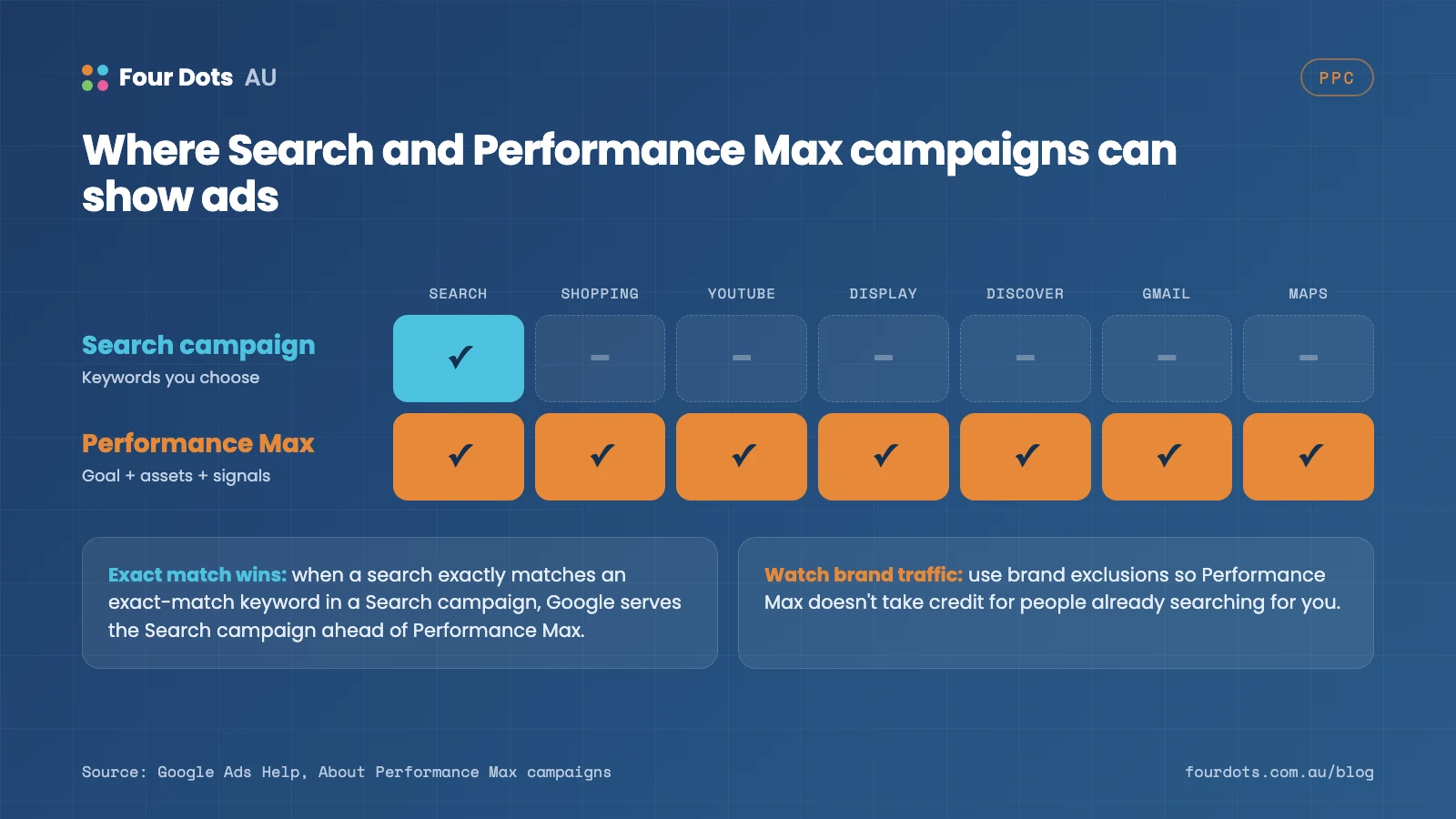
Performance Max (PMax) is a goal-based campaign that runs across all of Google’s inventory from a single campaign: Search, Shopping, YouTube, Display, Discover, Gmail and Maps. You supply assets (headlines, descriptions, images, videos), audience signals and a conversion goal, and Google’s automation decides where, when and to whom ads are shown. Control over placements and search terms is more limited, although Google has gradually added more reporting and exclusion options.
| Search campaigns | Performance Max | |
|---|---|---|
| Where ads show | Google Search (and optionally search partners) | All Google channels from one campaign |
| Targeting | Keywords and match types you choose | Assets, audience signals and search themes; Google decides |
| Search term visibility | Full search terms report | Search term reporting, with fewer controls |
| Creative needed | Text ads | Text, images, video and a product feed for retail |
| Conversion data needed | Works with low volume | Performs best with steady conversion volume |
| Best fit | High-intent lead generation, tight budgets | Ecommerce and accounts ready to scale |
When Search makes more sense
- Lead generation with clear intent: plumbers, lawyers, clinics and B2B services where people search for exactly what you offer.
- Tight budgets: with limited spend, you want every dollar on high-intent searches rather than spread across display and video.
- Limited conversion data: automated campaigns and Smart Bidding need a reliable volume of conversions to learn. Without it, Search with careful keyword control is usually more efficient.
- Brand and compliance control: regulated industries often need to know exactly which queries trigger ads and what the ads say.
When Performance Max makes more sense
- Ecommerce with a product feed: PMax has largely replaced Standard Shopping as the main way to run Shopping ads at scale, and it often performs strongly for retailers. Our Google Shopping team builds the feeds that make it work.
- Accounts with solid conversion volume: the more good conversion data Google has, the better the automation performs.
- Reaching new audiences: PMax can find demand on YouTube, Discover and Display that Search alone won’t reach.
- Strong creative assets: good images and video give PMax more to work with across its channels.
Running both together
Many accounts benefit from a hybrid approach: Search campaigns covering core, high-intent keywords and brand terms, with Performance Max layered on for Shopping and broader reach. Google’s documentation states that when a query hits an exact-match keyword in a Search campaign, that campaign is prioritised over Performance Max, which helps keep your most important terms under direct control. Watch for overlap, though. PMax can claim credit for branded searches and remarketing conversions that would have happened anyway, so consider brand exclusions and judge PMax on incremental results rather than reported conversions alone.
Common mistakes
- Launching PMax with weak or misconfigured conversion tracking, so the automation optimises toward the wrong actions. (We cover the most common causes in GA4 conversion tracking mistakes.)
- Counting low-value actions (page views, button clicks) as primary conversions.
- Uploading generic stock imagery and a handful of headlines, then expecting strong results.
- Judging performance after a few days, before the campaign has finished learning.
- Letting PMax absorb brand traffic and calling the result growth.
FAQ
Can I run Performance Max and Search at the same time?
Yes, and many accounts should. Keep core and brand terms in Search with exact match, use brand exclusions in PMax, and judge PMax on incremental results.
How much conversion data does Performance Max need?
Google doesn’t set a hard minimum, but automation learns faster with steady weekly conversions. If you only get a handful a month, start with Search and fix tracking first.
Is Performance Max good for lead generation?
It can work, but it’s prone to low-quality leads if it optimises toward easy form fills. Import qualified-lead or offline conversion data so it learns what a good lead looks like. A Google Ads audit will show whether your setup is ready.
The practical answer
For most service businesses, start with well-structured Search campaigns and accurate conversion tracking, then test Performance Max once you have reliable data and good creative. For most ecommerce businesses, PMax with a well-optimised product feed is the core, supported by Search for brand and key categories. Our Google Ads management team can audit your current setup and recommend the right mix for your goals.