When organic traffic falls off a cliff, the word “penalty” gets used a lot. But there are two very different things that can cause a sudden drop, and they need different responses. Getting the diagnosis right first saves months of wasted effort.
Manual actions: a human reviewer has flagged your site
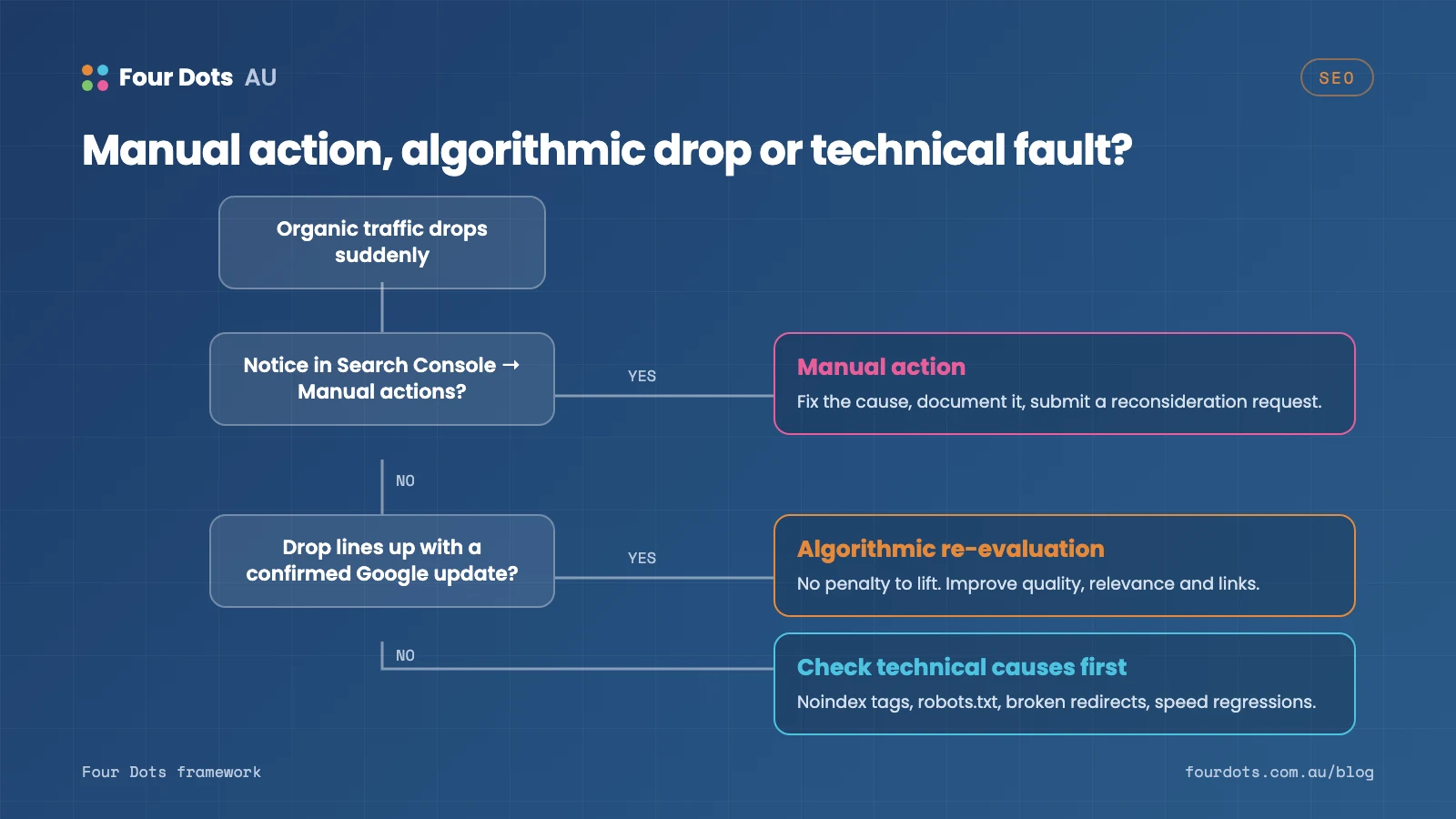
A manual action is applied by a member of Google’s team after reviewing your site against its spam policies. The good news is that you’ll be told about it. Manual actions appear in the Manual Actions report in Google Search Console, under Security & Manual Actions → Manual actions, along with the type of issue and whether it affects the whole site or specific pages.
Common manual action types include:
- unnatural links to your site;
- unnatural links from your site;
- thin content with little or no added value;
- pure spam or cloaking;
- user-generated spam (for example, in comments or forums);
- structured data issues.
How to recover from a manual action
- Read the notice carefully. It tells you the category of problem and its scope.
- Fix the cause thoroughly. For link penalties that means auditing your backlinks (our guide to spotting a toxic backlink profile explains how), requesting removal of manipulative links and disavowing those you can’t remove. For content issues it means improving or removing the offending pages.
- Document the work. Keep records of what you found, what you changed and who you contacted.
- Submit a reconsideration request from the Manual Actions report. Explain the problem, what you did to fix it and how you’ll prevent it happening again. Be honest and specific.
- Wait for the review. If the request is rejected, the response usually indicates what’s still wrong. Fix it and resubmit.
Once a manual action is revoked, rankings don’t necessarily snap back to where they were, especially if they were propped up by the links you’ve now removed. Recovery then becomes a matter of building quality signals properly.
Algorithmic drops: no one has penalised you
Far more common than manual actions are drops caused by Google’s ranking systems re-evaluating your site, typically around a core update, spam update or helpful content-related change. There’s no notice in Search Console and no reconsideration request to submit, because technically nothing has been applied to your site. Google’s systems have simply decided other pages better satisfy those searches.
How to diagnose an algorithmic drop
- Compare the date of the drop with Google’s confirmed ranking updates on the Google Search Status Dashboard.
- Identify which pages and query types lost visibility. Is it sitewide, a single section, or one type of content?
- Look at who now ranks instead of you and what their pages do better.
- Rule out technical causes first: accidental noindex tags, robots.txt changes, broken redirects after a migration, or a sudden speed regression.
How to recover
Algorithmic recovery is about improving the site, not undoing a penalty. Google’s own guidance on core updates makes the same point: there’s nothing to “fix” in the penalty sense, only content and experience to improve. Strengthen or consolidate thin pages, remove content that exists only for search engines, demonstrate real expertise and first-hand experience, improve the experience on key templates, and earn quality links. Improvements are usually reflected gradually, and sometimes most visibly at the next significant update.
Quick way to tell them apart
| Manual action | Algorithmic drop | |
|---|---|---|
| How you find out | Notice in Search Console | No notice; traffic and rankings fall |
| Cause | A reviewer found a spam policy breach | Ranking systems re-evaluated your pages |
| Scope | Site-wide or specific pages, stated in the notice | Often a section or content type |
| Fix | Remove the violation, document the work | Improve quality, relevance and authority |
| Reconsideration request | Yes | Not available |
| Recovery timing | After the request is reviewed and approved | Gradual, often visible at a later update |
If there’s no notice and no update, but traffic dropped suddenly, check for technical problems first. A technical SEO audit rules them in or out quickly.
FAQ
How long does a reconsideration request take?
Google doesn’t publish a fixed timeframe. Reviews commonly take anywhere from several days to a few weeks. You’ll get a message in Search Console when it’s processed.
Will rankings return after a manual action is lifted?
Not necessarily to previous levels. If the old rankings depended on the links or content you removed, you’ll need to rebuild with legitimate signals.
Is a core update a penalty?
No. Core updates re-assess how well pages satisfy searches. Sites that lose visibility haven’t broken a rule; other pages have been judged more helpful.
Need a hand?
Penalty recovery rewards experience: knowing which links genuinely need removing, how to write a reconsideration request that succeeds, and how to rebuild visibility afterwards. Our Google penalty removal team has handled both manual and algorithmic recoveries and can tell you quickly which one you’re dealing with.